ABOUT
Anna Cassel
Swedish Artist and Spiritual Pioneer
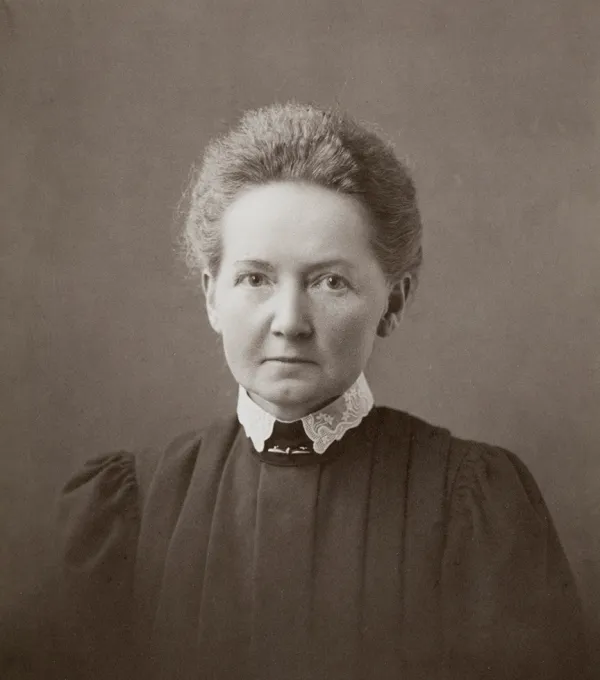
Anna Maria Augusta Cassel
Anna Cassel was a significant Swedish artist whose legacy bridges the worlds of classical landscape painting and spiritual modernism. Born near Grythyttan and active in Stockholm, Cassel played a pivotal role in the history of abstract art as a co-founder of De Fem (The Five) and the lifelong artistic partner and benefactor of Hilma af Klint.
Biography and Early Life
Born on March 15, 1860, Anna Cassel came from a wealthy background, the daughter of company manager Per August Cassel and Josefina Ramberg. She resided at Engelbrektsgatan 31 in Stockholm with her mother and sisters, Lotten, Emma, and Elin.
Her artistic education began in 1878 at Slöjdskolan (later Tekniska skolan, now Konstfack), and she continued her formal training at the Academy of Fine Arts in Stockholm.
While Cassel is historically recognized for her atmospheric landscapes painted in oil or tempera; capturing the beauty of Norrland, Skåne, Västmanland, and the Stockholm archipelago, her impact extended far beyond traditional canvas work. Her brother-in-law, Karl Öhman, described her profound influence on those around her:
"Anna Cassel gave me another direction. Not through any moral nor philosophical discussion, but through her moral artistic personality. Her strong personality had a strong impact on me, and art the moderating context."
Anna Cassel and Hilma af Klint
Anna Cassel is perhaps best known for her lifelong friendship and collaboration with Hilma af Klint. The two met during their studies in 1878 and bonded over a shared dedication to spiritual movements.
Cassel’s financial independence allowed her to become a vital patron for af Klint. She financed the construction of the famous studio on the island of Munsö, inaugurated in 1917. This studio became the sanctuary where Hilma af Klint’s groundbreaking works were stored, preserving them for future generations.
Both women were deeply involved in the spiritualist awakening of the turn of the century:
Edelweiss Society: Cassel was a member alongside af Klint.
Theosophy: In 1904, Cassel joined the Theosophical Lodge of Stockholm, following in the footsteps of her sister Lotten.
The Anthroposophical Society: Cassel joined the Anthroposophical Society in 1920 alongside af Klint and was a member until her death.
De Fem and Spiritual Automatism
In 1896, Anna Cassel and Hilma af Klint co-founded the spiritualist group De Fem (The Five). The group included Sigrid Hedman, Mathilda Nilsson, and Cornelia Cederberg.
Beginning as a spiritualist circle, De Fem evolved into a groundbreaking artistic collective. They conducted séances using a psychograph (an instrument for recording spirit writings) and trance mediums to communicate with spirit leaders, primarily named Gregor, Georg, Clemens, Ananda, and Amaliel.
The Birth of Automatism
Through these spiritual exercises, the group developed a technique of automatic drawing, decades before the Surrealists made the term "automatism" famous.
During their sessions, the women allowed their hands to move without conscious will, acting as artistic tools for their spiritual guides. This process resulted in sketchbooks filled with religious scenes, symbols, and eventually, abstract patterns.
Although De Fem ceased formal meetings in 1907, the collaboration did not end. Anna Cassel remained a key figure, assisting Hilma af Klint with the monumental Paintings for the Temple.